
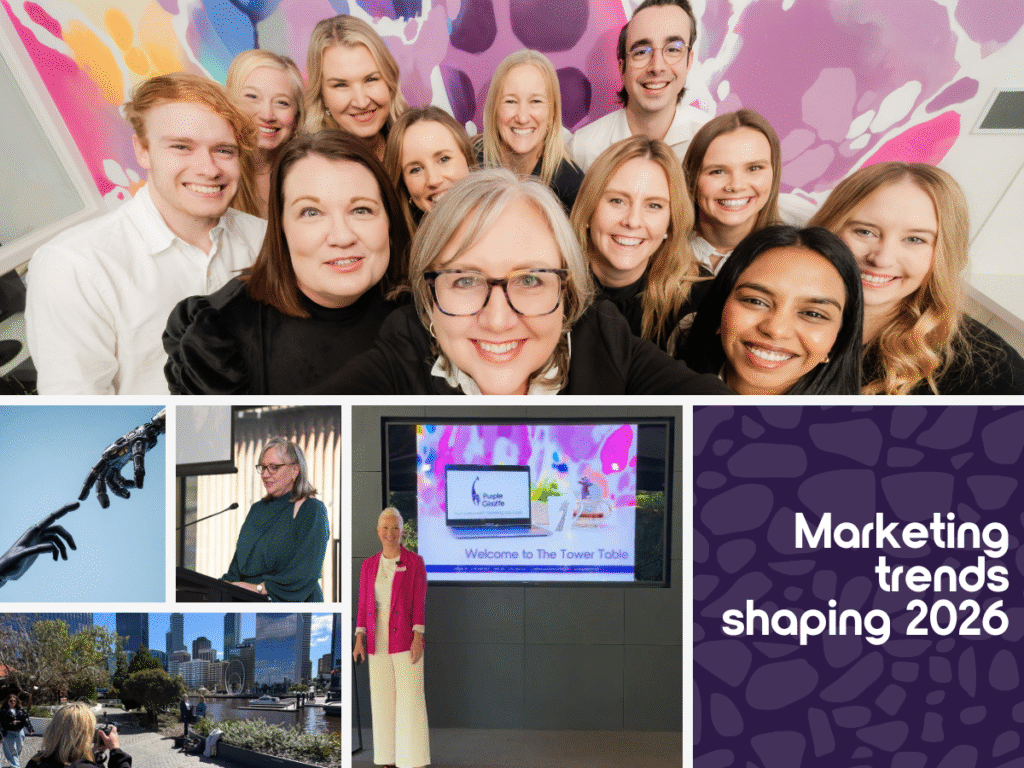
If there’s one thing we know about marketing heading into 2026 it’s this: doing more won’t be the answer.
This year will be shaped by rapid advances in AI, changing discovery habits, fractured digital platforms and rising expectations around trust and relevance. For many businesses, this will feel overwhelming.
But beneath the noise, a clear pattern is emerging – the brands that perform best won’t be the loudest or the fastest. They’ll be the clearest.
Here are a handful of ways we’re see the landscape shift and what it means for businesses looking to stay focused, credible and effective.
1. Search is no longer just search
Search behaviour has changed!
It’ll be no surprise to read but people are increasingly turning more and more to AI-powered tools like ChatGPT and Google’s AI overviews to get direct answers – rather than scrolling through pages of results.
In many cases, these tools are becoming the first place people look for information.
This has significant implications for marketing. Traditional SEO still matters, but it’s no longer enough. Businesses now need to consider how their brand appears in AI-generated responses, what information is being surfaced, how accurate it is, and whether it reflects their positioning.
Generative Engine Optimisation (GEO) is a key player here, and this is simply the practice of preparing your content for AI-driven search. It ensures your brand appears in AI-generated responses on platforms like ChatGPT, Perplexity, Copilot, and Google AI Overviews.
In short, GEO is about:
- Anticipating the questions your audience is asking
- Creating clear, comprehensive, and credible content that AI can easily interpret
- Positioning your brand where users are increasingly finding answers
Businesses that embrace GEO alongside SEO will stay visible and relevant as this landscape continues to evolve.
The takeaway is simple: clarity and authority matter more than ever. Clear explanations, up-to-date information and consistent messaging help ensure your brand is represented accurately — whether a human or an AI is doing the searching.
2. Social SEO is the new top of funnel
With this search behaviour shifting it’s important for marketers to optimise content for in-platform search, not just Google. Clear, keyword-led captions, explainer content, short-form video series and pinned Q&As all play a role in improving visibility.
Social SEO isn’t about chasing algorithms, it’s about understanding how people search, ask questions and engage within each platform’s community.
Brands that treat social platforms as core top-of-funnel channels will stay visible and relevant. Those that don’t risk being overlooked where discovery is increasingly happening.
3. Your reputation now extends into AI
Reputation management has expanded beyond media coverage and social commentary. Journalists, researchers and decision-makers are increasingly using AI tools as part of their research process.
That means outdated or incorrect information can quietly influence perception long before a conversation ever reaches you.
In 2026, brands that take reputation seriously will actively review how they appear in AI-generated outputs and ensure their owned content reflects who they are today, not who they were several years ago.
This isn’t about trying to play the system. It’s about maintaining control of your narrative by keeping your digital foundations accurate, consistent and considered.
4. Video everywhere (and in every format)
Video continues to dominate attention, but not in one-size-fits-all ways. Short-form drives discovery, while long-form, podcasts and episodic content are building deeper engagement and loyalty. Live and shoppable video are also gaining momentum, bringing commerce, entertainment and community closer together.
The opportunity isn’t just to do more video, but to be intentional. Use short-form to attract, longer formats to nurture, and interactive content to convert. Video takes investment, but brands that underplay it risk losing relevance in an increasingly competitive digital landscape.
5. Multi-platform engagement is the baseline
Your audience isn’t on one platform, they’re moving across many.
Today’s challenge isn’t choosing channels, it’s choosing the right ones and creating a joined-up experience across them. People experience your brand as a whole, so consistency and cohesion matter more than ever.
Strong multi-platform strategies balance planning with agility. Content should be tailored to each platform’s culture while staying anchored to a clear brand narrative, with the flexibility to adapt based on real-time engagement. Brands that integrate their storytelling across channels build trust and momentum; those that treat platforms in isolation dilute impact.
Multi-platform engagement isn’t optional anymore – it’s the minimum expectation.
6. AI is becoming a teammate not just a tool
AI is moving beyond task automation into something more meaningful, supporting entire workflows across research, planning, execution and reporting.
Used well, this can free up time and mental space for the work that packs a bang like strategy, creativity and problem-solving. Used poorly, it risks adding noise, shortcuts and inconsistency.
The opportunity in 2026 isn’t simply adopting AI – it’s integrating it thoughtfully. Businesses that treat AI as a support mechanism, rather than a replacement for thinking, will gain the most value.
7. Trust is a strategic asset
Misinformation manipulated content and deepfakes are no longer fringe issues. They’re ongoing risks.
False narratives spread quickly, and corrections rarely travel as far. For businesses, this means trust can be damaged quietly and at speed – particularly if there’s no plan in place.
In 2026, proactive monitoring and clear crisis protocols will be just as important as cybersecurity or data privacy. Brands that invest in resilience (not just reaction) will be far better placed to protect their reputation over the long-term.
8. Influence is being redefined
Influencer marketing is maturing.
Rather than focusing on reach or follower counts, brands are increasingly prioritising partnerships that deliver real outcomes – whether that’s traffic, conversions or measurable brand impact.
At the same time, communities like Reddit are playing a larger role in shaping opinions, particularly in complex or high-consideration categories. These spaces value authenticity and contribution, not promotion.
The shift is clear: credibility beats visibility. Brands that understand their audience and engage genuinely will build influence that lasts beyond a single campaign.
9. Personalisation is finally practical with care
Advances in AI mean personalisation is no longer limited to basic demographics. Messaging can now be shaped around behaviours, values and interests at scale.
But with this capability comes responsibility. Personalisation needs to feel helpful, not invasive. Relevant, not robotic.
Businesses that balance automation with empathy will be best placed to build stronger relationships and long-term loyalty.
10. Measurement is catching up
Vanity metrics are losing their shine.
For a long time, marketing has leaned on the same familiar numbers. Likes, impressions, reach and views. They are easy to pull together and look reassuring in a report, but in our work supporting organisations across different sectors, we often see a gap between those numbers and what people actually want to understand.
In 2026, marketing teams will be expected to demonstrate real impact, connecting activity to outcomes like reputation, demand and business growth. Unified measurement across paid, earned, shared and owned channels is becoming the benchmark.
This shift isn’t about more reporting. It’s about better insight and using it to make smarter decisions.
What it all comes back to
Across every trend, one theme stands out: clarity.
Clear messaging, clear priorities, clear alignment between strategy and execution.
The brands that succeed in 2026 won’t be chasing every new platform or tool. They’ll be grounded in who they are, who they’re speaking to and what they’re trying to achieve – using technology to support that clarity, not replace it.
At Purple Giraffe, that’s the approach we believe in. Marketing that’s considered, aligned with your business goals and built for the long-term, even as the landscape continues to evolve.
Talk to the team at Purple Giraffe to get your marketing ball rolling!
Special shout out to Meltwater and ChatGPT for helping write this blog.
Original Meltwater eBook